Every vessel has its own limitations. The available deck area may be narrow, the lifting point may sit several meters away from the proposed installation position, and existing structures can restrict both boom movement and maintenance access. At the same time, the crane must handle the required loads without placing excessive demands on the vessel's structure. These conditions make marine crane engineering fundamentally different from selecting a lifting machine from a standard specification sheet.
In a practical vessel project, the crane has to fit the ship before it can perform its job. Its capacity, outreach, foundation, boom arrangement, drive system and control configuration all need to work within the vessel's physical and operational boundaries. A successful solution therefore begins with understanding how and where the crane will be used, then translating those requirements into an engineered lifting system.
Marine lifting equipment operates within a moving and highly constrained environment. Unlike many land-based lifting applications, the crane foundation, surrounding structures, available clearance, and vessel operating condition are interconnected.
A crane positioned too close to a superstructure may have sufficient capacity but insufficient outreach. A crane with adequate outreach may require a foundation that cannot be accommodated without reinforcing the deck. Similarly, a lifting solution that works effectively in port may need additional consideration if the vessel is expected to perform lifting operations offshore or in exposed conditions.
This makes the vessel itself part of the crane design. Engineers typically need to consider:
Vessel type and principal dimensions
Available crane installation area
Required working radius and hook height
Maximum and typical lifted loads
Load distribution and lifting frequency
Deck structural capacity and foundation arrangement
Hydraulic or electrical power availability
Stowed position and interference with other equipment
Environmental and marine operating conditions
The most useful way to evaluate a crane requirement is to connect the operating task with measurable engineering parameters. Capacity, radius, boom configuration, and foundation loads should be considered together rather than treated as separate specifications.
| Parameter | What It Determines | Why It Matters on a Vessel |
|---|---|---|
| Rated lifting capacity | Maximum permissible load under defined conditions | Must match actual cargo, stores, maintenance, or equipment-handling requirements |
| Working radius | Horizontal distance from the crane to the lifting point | Directly affects usable lifting capacity and whether the hook can reach the required area |
| Hook height | Vertical lifting envelope | Influences clearance above deck, hatch openings, cargo and surrounding structures |
| Boom configuration | Reach, articulation and positioning capability | Determines how effectively the crane can operate around vessel structures |
| Foundation loads | Forces and moments transferred into the vessel | May require local reinforcement or a dedicated foundation structure |
| Drive system | Method used to power crane movements | Must be compatible with the vessel's available hydraulic or electrical systems |
| Stowed envelope | Space occupied when the crane is not operating | Prevents interference with navigation, cargo handling and deck access |
The key point is that these parameters interact. Increasing outreach, for example, can change the load moment and therefore influence both the permissible working load and the structural requirements of the foundation.
Working radius is one of the parameters most likely to be underestimated during early-stage crane selection. A vessel may require a crane to lift a relatively modest load, but the lifting point may be located far from the crane pedestal. In that situation, the required radius can become more important than the nominal maximum capacity.
Engineers should therefore evaluate the expected lifting tasks using a load chart rather than relying on one headline capacity figure. The relationship between load and radius should be checked against the actual operating envelope, including the positions where the crane is expected to handle loads most frequently.
This is where crane safe working load becomes an important consideration. The relevant value is not simply the largest load the equipment can theoretically lift, but the permissible load at the required working radius and operating configuration.
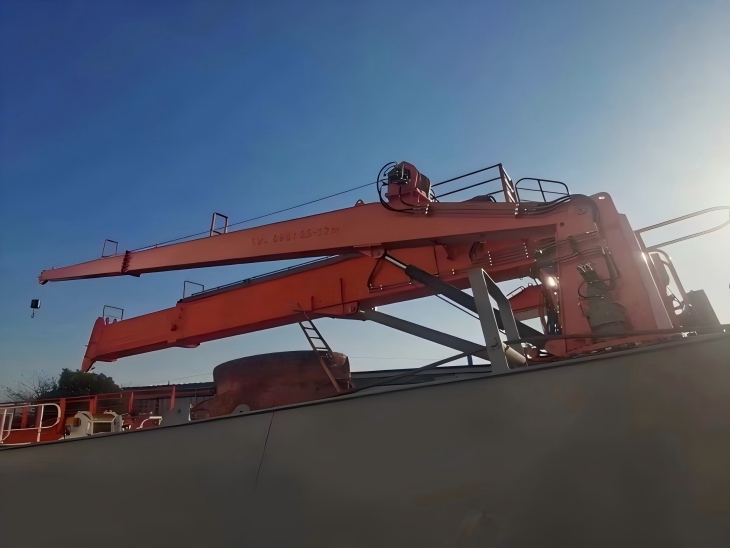
Installing a crane on a vessel is a structural task as much as it is an equipment task. The crane transfers vertical loads, horizontal forces and overturning moments into the supporting structure. If the foundation arrangement is not properly matched to the deck structure, the crane's lifting performance cannot be considered independently of the vessel.
The engineering review should therefore examine the pedestal or mounting arrangement, deck plating, supporting beams, local reinforcements and surrounding structures. Space is another practical constraint. The crane foundation must leave sufficient clearance for operation, maintenance and access while avoiding conflicts with hatches, pipelines, winches and other deck machinery.
For retrofit projects, this assessment becomes particularly important because the vessel already has an established structural arrangement. A new crane may require a foundation modification rather than simply being positioned on an available section of deck.
There is no single boom arrangement that suits every vessel. The required configuration depends heavily on where the crane is installed and what it must reach.
A conventional fixed boom arrangement can be appropriate where the working area is relatively open and predictable. Where deck space is limited or the crane must work around structures, a knuckle boom arrangement can provide greater positioning flexibility. Hydraulic slewing systems may also be advantageous where controlled rotation and smooth movement are important to the operating task.
For applications involving cargo transfer across the side of a vessel, a ship deck crane must be evaluated according to its actual working envelope rather than simply its rated capacity. The crane needs to reach the intended lifting points while maintaining adequate clearance from railings, superstructures and other equipment.
Restricted deck layouts create a different engineering challenge from simply specifying a higher-capacity crane. The equipment may need to fold, rotate or position its boom within a defined envelope when not in use.
This is particularly relevant on vessels where deck space is shared with cargo, pipelines, access routes, hatches or maintenance equipment. A crane that performs well during lifting but occupies excessive space when stowed may create operational problems elsewhere on the vessel.
For this reason, the design review should define at least three envelopes:
Operating envelope: the space required for the crane to complete its intended lifting movements.
Stowed envelope: the space occupied when the crane is folded, parked or secured.
Maintenance envelope: the clearance required for inspection, lubrication, hydraulic service and component replacement.
Considering all three at the design stage can prevent a common retrofit problem: equipment that fits physically but is difficult to operate or maintain once installed.
The crane's mechanical configuration is only one part of the system. Hydraulic and electrical requirements must also be compatible with the vessel's existing infrastructure.
For a hydraulic crane, engineers may need to confirm available hydraulic pressure, flow rate, reservoir capacity, filtration and cooling provisions. For an electrically driven system, the vessel's power supply, voltage, frequency, motor starting characteristics and control architecture should be reviewed.
Control requirements should reflect the lifting task as well. Precision positioning may be more important than maximum operating speed for maintenance or equipment-handling applications. In other cases, faster cycle times may be required for repetitive cargo operations.
A detailed technical request allows the crane manufacturer to develop a more accurate proposal and reduces the risk of repeated clarification during the engineering stage.
| Information Category | Recommended Input |
|---|---|
| Vessel information | Vessel type, dimensions, deck arrangement and installation location |
| Lifting requirement | Maximum load, typical load, lifting frequency and load-handling purpose |
| Reach | Minimum and maximum required working radius |
| Vertical clearance | Required hook height and nearby obstructions |
| Foundation | Existing pedestal or deck structure, drawings and allowable loads where available |
| Power | Hydraulic or electrical supply parameters available on the vessel |
| Operating environment | Port, coastal, offshore or other marine conditions |
| Certification | Applicable class, flag-state or project-specific certification requirements |
| Layout constraints | Hatches, railings, superstructures, pipelines and adjacent equipment |
Marine crane projects often involve several parties: shipowners, shipyards, naval architects, structural engineers, crane manufacturers and classification organizations. If crane requirements are defined too late, changes to the foundation or deck arrangement can affect both schedule and cost.
Early coordination allows the lifting envelope, foundation loads, power requirements and maintenance access to be reviewed before fabrication. It also gives the manufacturer a clearer basis for selecting the crane configuration instead of adapting a standard product after the vessel layout has already been finalized.
For newbuild vessels, this coordination can be incorporated into the initial deck arrangement. For retrofit projects, the same process helps determine whether the existing structure can accommodate the proposed crane or whether reinforcement is required.
A well-engineered marine crane solution is defined by how effectively the equipment works within the vessel's actual operating environment. Capacity must correspond to the required loads, reach must correspond to the lifting points, the foundation must support the resulting forces, and the control and power systems must integrate with the vessel.
That is why vessel-specific engineering should be treated as a design process rather than a product-selection exercise. When these requirements are evaluated together from the beginning, the resulting crane system can provide usable lifting performance without creating avoidable structural, spatial or operational constraints.


 English
 Español
 italiano
 português
 Nederland
 norsk
norsk