Access between a vessel and shore is rarely a simple matter of installing a ladder or extending a platform. Vessel freeboard, deck layout, quay height, tidal variation, working angle, available installation space, and the way people move on and off the vessel can all change the access requirements. A system that works well on a harbor service vessel may not be suitable for a larger commercial vessel or a vessel that regularly operates alongside different types of wharves.
That is why marine gangway design needs to begin with the vessel and its operating environment rather than with a standard product dimension. The right solution should provide a practical transition between ship and shore while fitting the available deck space, accommodating vessel movement, and maintaining safe access throughout the intended operating range.
Different vessels create different access problems. A small workboat may have limited deck space and a relatively low freeboard, while a larger commercial vessel may require a longer access arrangement because of the greater vertical distance between the working deck and shore.
Vessel type also determines how frequently the access system will be deployed and what kind of loads it may experience. A gangway used occasionally during port calls has a different duty profile from one used repeatedly by crew, technicians, contractors, or passengers.
For example, a vessel operating primarily in a fixed port environment may be able to use a relatively straightforward arrangement. A vessel visiting ports with different quay elevations may require greater adjustment capability. Workboats and service vessels may place greater emphasis on compact storage and rapid deployment.
For smaller vessels, a gangway for boat applications may need to balance lightweight construction with sufficient working length and convenient handling. For larger vessels, the design focus can shift toward structural capacity, landing geometry, and integration with existing deck equipment.
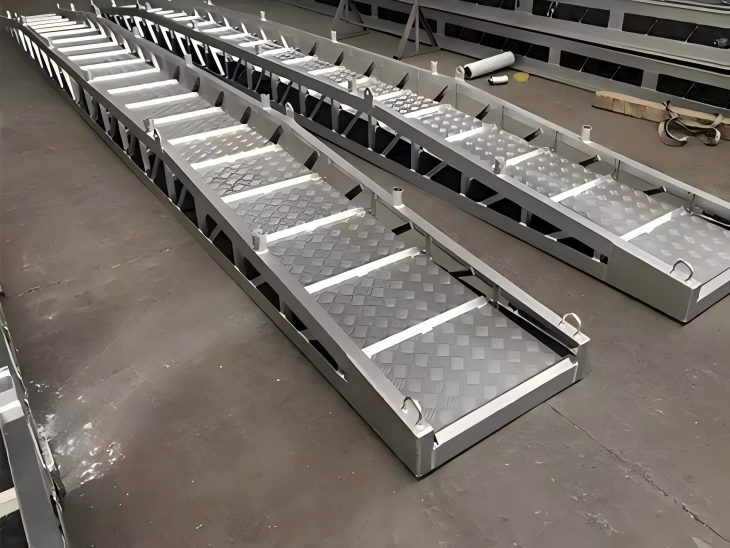
The vertical distance between the vessel's access point and the shore is one of the most important variables in gangway selection. It is not constant: loading conditions, cargo operations, tides, ballast changes, and vessel movement can all alter the relative height of the two ends.
A gangway therefore needs an operating range rather than a single nominal position. Its length should provide enough reach without forcing the system into an unsuitable working angle. At the same time, the landing arrangement must remain practical when the vessel moves within the expected operating envelope.
Consider a vessel working in a tidal port. If the shore rises or falls significantly relative to the vessel, a fixed-length access solution may become impractical at certain stages of the tide. A longer or more adjustable gangway can provide additional flexibility, provided that the supporting structure, landing area, and available deck space can accommodate it.
This is also why simply choosing the longest available gangway is not necessarily the best solution. Excessive length can increase weight, storage requirements, handling difficulty, and structural demands. The useful length is the length that covers the required access range while remaining compatible with the vessel.
Marine access is not always solved with the same type of equipment. Where the vessel's freeboard or operating arrangement makes a conventional gangway impractical, an accommodation ladder can provide a more appropriate route between the ship's deck and a lower landing position.
An accommodation ladder is particularly relevant when the access point is positioned on the vessel's side and the vertical difference between deck level and the external landing area is significant. Its geometry can be configured around the vessel's structure and the expected operating position.
For vessels with dedicated accommodation access, the available deck opening, stowage position, hinge arrangement, and supporting structure all need to be considered together. A longer ladder may provide greater reach, but it also introduces greater structural and handling requirements.
The distinction between a gangway and an accommodation ladder should therefore be based on the actual access geometry rather than simply on vessel size. The objective is to create a stable, usable route that matches how personnel actually board, disembark, or transfer between the vessel and shore.
For an accommodation ladder in ship application, the ladder itself is only one part of the overall system. Its upper connection, supporting structure, lower landing, handrails, stowage arrangement, and deployment method all influence practical performance.
The upper end needs to connect securely to the vessel while allowing the ladder to operate through its intended range. The lower end should provide a suitable landing or transition area instead of creating an awkward step between the ladder and the shore or platform.
Material selection is another consideration. Aluminum alloy is often attractive for marine access equipment because it can reduce overall weight while providing useful corrosion resistance. Lower equipment weight can also make deployment, adjustment, and storage easier, particularly where access equipment must be handled frequently.
However, lightweight construction should not be considered independently from structural requirements. The design still needs to account for the expected personnel load, distributed loading, supporting points, movement, and operating conditions.
A vessel alongside a berth is never completely stationary. Wind, waves, current, loading changes, and mooring conditions can cause relative movement between the ship and the shore. The access system therefore has to accommodate the movement expected in its operating environment.
This becomes particularly important at the lower landing point. If the shore-side support is fixed while the vessel moves vertically or horizontally, the gangway must have enough freedom and adjustment capability to avoid transferring inappropriate forces into the vessel or shore structure.
The design should also consider the vessel's movement at the time of boarding rather than relying only on static dimensions. A configuration that appears correct when the vessel is level may become less practical when the ship rises, falls, or moves away from the quay.
For vessels operating in exposed environments, this consideration becomes even more important. The expected sea state, mooring arrangement, operational restrictions, and frequency of personnel transfer should all be incorporated into the engineering assessment.
Not every vessel needs a permanently installed access system. A demountable gangway can be useful when deck space is limited, access equipment is required only during specific operations, or the vessel has different configurations for different missions.
Demountable equipment can also simplify storage when the gangway is not required. Instead of occupying a permanent position at the vessel's side, it can be removed and stored elsewhere on board or in a designated shore-side area.
The trade-off is that handling becomes part of the operating procedure. The weight of the gangway, lifting points, securing arrangements, storage location, and deployment method all need to be considered. If another piece of deck equipment is required to position the gangway, its lifting capacity and operating envelope should also be checked.
This makes demountable designs particularly useful for vessels where access requirements change according to the task rather than remaining constant throughout the vessel's service life.
A reliable quotation or engineering review should begin with actual vessel dimensions rather than only a requested gangway length. Providing the correct project information allows the manufacturer to assess whether the proposed access arrangement can operate effectively.
| Parameter | Why It Matters |
|---|---|
| Vessel type | Defines the general operating environment and access arrangement. |
| Access deck height | Determines the vertical distance that the gangway or ladder needs to overcome. |
| Shore or quay height | Defines the opposite end of the access geometry. |
| Required working length | Determines whether the equipment can cover the required access range. |
| Available deck width | Influences installation, movement, and storage requirements. |
| Mounting position | Determines how the equipment can be connected to the vessel. |
| Operating angle | Affects usability, transition, and overall access configuration. |
| Personnel load | Provides an important basis for structural and safety assessment. |
| Storage position | Ensures the gangway can be secured when not in use. |
| Deployment method | Determines whether manual handling, lifting equipment, or another mechanism is required. |
These parameters are more useful than simply specifying “a 10-meter gangway” because they describe the conditions under which the equipment must actually work.
Safety features should be considered as part of the access system rather than added after the main structure has been designed. Handrails, non-slip walking surfaces, suitable landing areas, secure attachment points, and appropriate edge protection all contribute to safe personnel movement.
The surrounding deck arrangement is equally important. A well-designed gangway can still create operational problems if personnel have to step over obstacles, pass through restricted areas, or make an abrupt transition between the gangway and deck.
For an accommodation ladder on ship, the handrail arrangement and lower landing configuration should be evaluated together with the ladder angle and available clearance. This helps prevent the access route from becoming difficult to use when the vessel or ladder changes position.
Securing the equipment when it is not in operation is another important consideration. Marine access equipment may be exposed to vibration, wind, salt spray, and vessel movement. Proper stowage and securing arrangements can help reduce unnecessary loads and extend service life.
Even when the required length and load capacity are already known, the available deck arrangement can determine whether a particular design is practical.
The mounting area may be close to railings, hatch covers, winches, cranes, pipes, doors, or other deck equipment. These surrounding structures can restrict the movement of the gangway or interfere with its storage position.
For this reason, the design process should include the complete installation area rather than treating the gangway as an isolated component. The manufacturer may need deck drawings, photographs, mounting dimensions, access-point locations, and information about nearby structures before finalizing the arrangement.
For vessels with complex deck layouts, the relationship between the access system and other equipment is particularly important. Clearance should be checked not only in the normal working position but also during deployment, adjustment, and stowage.
A detailed request for quotation can significantly reduce the amount of back-and-forth required during engineering. In addition to the desired product type, buyers should provide the operating information that determines the actual configuration.
Vessel type and main dimensions
Access location and deck height
Typical and maximum shore-side height
Required gangway or ladder length
Expected operating angle or access range
Personnel or working load requirements
Available mounting dimensions
Preferred material and surface treatment
Deployment and lifting method
Storage or stowage requirements
Applicable classification, certification, or project requirements
Drawings, photographs, or deck layout information
These details help distinguish a genuinely suitable solution from a product that only matches the requested length on paper.
The most effective marine access solution is rarely determined by one specification. Length, width, material, load, angle, mounting position, and storage arrangement interact with one another. Changing one parameter can affect several others.
For example, increasing the required length may influence the overall weight and supporting structure. Moving the mounting point may change the working angle. Increasing the expected personnel load may affect structural dimensions and attachment requirements. Changing the storage location can also alter the required lifting or handling method.
That is why vessel-specific engineering is valuable even when a project appears to require a standard product. A standard design can provide a starting point, but the final arrangement should reflect the vessel's actual dimensions, operating conditions, and access procedures.
Marine gangway selection should ultimately answer a practical question: can the proposed system provide reliable access under the conditions in which the vessel will actually operate?
For some vessels, a compact gangway may be the most practical answer. Others may require a longer accommodation ladder, a demountable configuration, or a customized arrangement that integrates with existing deck structures. The correct solution depends on the relationship between vessel geometry, shore conditions, personnel movement, and equipment handling.
By defining these factors at the beginning of the project, shipowners, operators, shipyards, and marine equipment buyers can avoid choosing equipment based on length or appearance alone. A properly engineered access system should fit the vessel, work within its intended operating range, and remain practical to deploy, use, and secure throughout its service life.


 English
 Español
 italiano
 português
 Nederland
 norsk
norsk