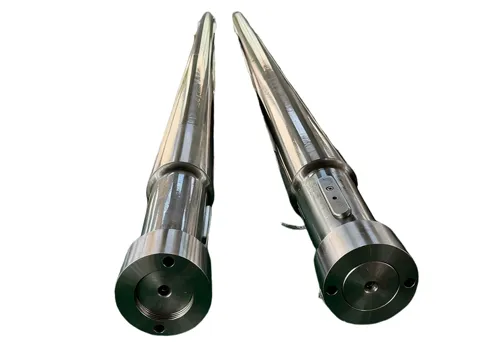
Dock and vessel heights rarely remain constant during marine operations. A vessel's freeboard can change with cargo, ballast, and fuel conditions, while quay elevation and water level can vary with tide. These changes directly affect the angle, reach, landing position, and support requirements of a marine access system. For this reason, access equipment should be designed around the vessel-to-dock height range rather than a single static measurement.
The most suitable solution depends on the relationship between vessel freeboard, quay height, horizontal gap, expected vessel movement, and available installation space. A properly engineered system may involve a conventional gangway, an accommodation ladder, a longer wharf access arrangement, or a customized combination of components.
The vertical difference between the vessel's access deck and the shore-side landing point determines the basic access geometry. As this difference increases, the system generally needs greater effective length to maintain a practical operating angle.
However, the height difference should be calculated as a range rather than a single value. A vessel may sit higher or lower in the water depending on its loading condition, and the dock-side elevation can change relative to the vessel because of tidal movement. The access system therefore needs sufficient adjustment capability to remain usable across the expected operating conditions.
For example, a vessel with a relatively low freeboard operating at a high quay may require only a compact access arrangement. The same vessel at a lower berth could require substantially more reach. Conversely, a high-freeboard vessel may need an accommodation ladder rather than simply adding length to a conventional gangway.
Gangway length should be derived from the required vertical rise, horizontal reach, and acceptable working angle. Selecting equipment solely according to the distance between the vessel and dock can produce an unsuitable result because the access angle may become excessive when the height difference changes.
| Design Parameter | Why It Matters | Typical Design Effect |
|---|---|---|
| Vessel freeboard | Defines the elevation of the vessel-side access point | Influences required access length and angle |
| Quay elevation | Defines the shore-side landing height | Determines the vertical difference to be overcome |
| Horizontal gap | Changes the required reach between vessel and shore | Influences overall gangway geometry |
| Tidal range | Changes the relative position of vessel and dock | May require additional adjustment range |
| Loading condition | Changes vessel draft and freeboard | Creates additional operating height variation |
| Available deck space | Limits mounting and stowage options | Can restrict practical gangway length |
| Personnel load | Determines structural loading requirements | Influences construction and support design |
A longer gangway is not automatically better. Increasing length can reduce the inclination for a given height difference, but it also increases equipment weight, storage requirements, structural loads, and handling demands. The objective is to achieve sufficient access range without creating unnecessary complexity.
The choice depends on the access geometry and the vessel's operating conditions. A marine gangway is generally suitable where the vessel has a practical side access point and the shore-side landing can be reached within the gangway's working range.
For vessels with greater freeboard or a more substantial vertical transition, an accommodation ladder may provide a better solution. Instead of forcing a conventional gangway to bridge the entire height difference, the access arrangement can use a ladder to create a controlled transition from the vessel's deck toward a lower landing position.
This distinction becomes particularly important when deck space is restricted. Increasing gangway length may require a larger stowage area or a stronger mounting structure, while an accommodation ladder may fit the vessel's existing arrangement more effectively.
High-freeboard vessels require more than additional reach. Their access systems must deal with greater vertical movement and often need a carefully designed connection between the upper deck and lower landing point.
An accommodation ladder in ship applications should therefore be evaluated as a complete system. The ladder length, upper hinge or mounting point, lower landing arrangement, handrails, support structure, and stowage position all affect performance.
Material selection can also influence the practicality of the design. Aluminum alloy is often considered for accommodation ladders because its lower weight can simplify handling and deployment. This can be especially useful where the equipment is frequently adjusted or moved between operating and stowed positions.
Weight reduction, however, does not eliminate the need for structural assessment. The ladder and its supporting components still need to accommodate the expected personnel load and the forces generated during normal operation.
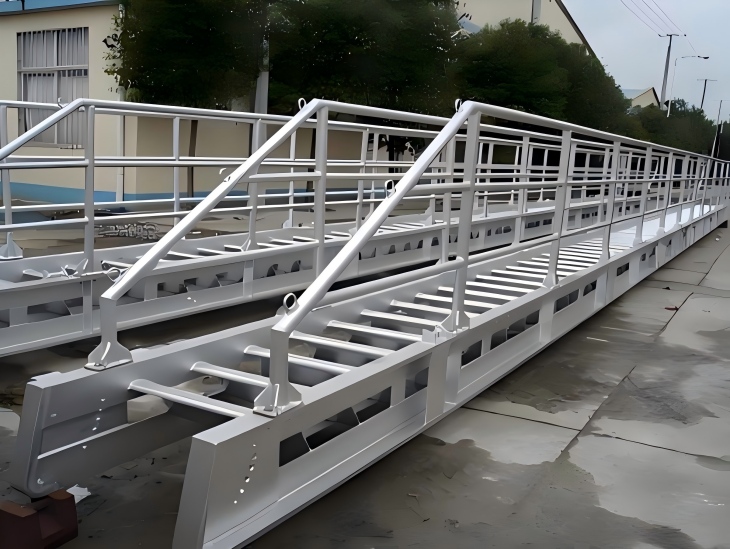
Tidal variation can transform an otherwise straightforward access arrangement into a variable-geometry problem. When the water level changes, the vessel's position relative to the quay changes as well. The gangway may become steeper or flatter, and the landing point can shift accordingly.
The system should therefore be designed with a defined operating envelope. Instead of asking whether a gangway works at one specific dock height, the engineering question should be whether it remains functional between the minimum and maximum expected vessel-to-quay elevations.
This approach is particularly important for vessels that regularly operate in ports with significant tidal ranges. Adjustment capability, landing support, connection geometry, and equipment length should all be evaluated against the full range of expected conditions.
Another factor is vessel loading. A vessel carrying a heavy cargo load may sit lower in the water than when lightly loaded. Consequently, the same berth can produce different access heights during different operating stages.
A wharf-side application places greater emphasis on the relationship between the vessel and the fixed shore structure. The gangway needs to reach a suitable landing surface while accommodating the relative movement of the vessel.
A wharf gangway can therefore be designed around the dimensions and operating conditions of the specific berth. Its effective length, landing arrangement, support points, and movement capability should be considered together rather than selected independently.
The landing surface itself is an important part of the design. A gangway may have sufficient length but still be impractical if its shore end cannot rest securely on a suitable surface. Edge geometry, available clearance, quay structures, and nearby obstacles should be checked during the engineering stage.
Height is only one component of the access problem. A vessel alongside a dock can move vertically and horizontally because of waves, wind, current, mooring conditions, loading changes, and other operational factors.
This creates a distinction between static access geometry and dynamic access conditions. Static geometry defines where the gangway needs to reach. Dynamic conditions determine how much relative movement the system must tolerate while remaining stable and usable.
The vessel-side connection should therefore be designed to accommodate the expected movement without imposing inappropriate forces on the deck structure. At the shore end, the landing arrangement must remain secure as the vessel changes position.
For vessels operating in sheltered harbors, the movement envelope may be relatively limited. Vessels exposed to more variable conditions may require a more carefully engineered combination of adjustment, support, and operational restrictions.
Changes in access angle can affect how personnel use the system, making safety features an integral part of the design. Handrails, non-slip walking surfaces, secure attachment points, suitable landing areas, and appropriate edge protection should be considered from the beginning of the project.
The transition between gangway and vessel deck is particularly important. Even when the main structure is correctly sized, an abrupt step, insufficient clearance, or poorly positioned landing can create an operational hazard.
The shore-side end should receive the same attention. The landing area needs to provide a stable surface and sufficient space for personnel to transition between the access system and dock. Surrounding structures should also be checked for interference during deployment, adjustment, and stowage.
Where height changes are substantial, operators should also define the conditions under which the access system can be safely used. A technical design can provide a working range, but operating procedures are necessary to ensure that the equipment remains within that range.
For a height-sensitive marine access project, a manufacturer can provide a more accurate recommendation when the initial inquiry includes actual vessel and berth information. The following data is particularly valuable:
Vessel type and principal dimensions
Minimum and maximum freeboard at the access point
Minimum and maximum dock or quay height
Horizontal distance between vessel and dock
Expected tidal variation
Normal and maximum vessel loading conditions
Required access length and working range
Expected personnel load
Available mounting and stowage space
Deployment and handling method
Photographs or drawings of the installation area
Required certificates, standards, or classification documentation
Providing minimum and maximum dimensions is particularly useful. A single measurement describes only one operating condition, while a range gives the manufacturer the information needed to assess whether the proposed system can accommodate real-world changes.
The most reliable solution comes from matching the access system to the complete operating envelope rather than selecting equipment by nominal length alone. Low-freeboard vessels, high-freeboard vessels, fixed docks, tidal berths, and vessels with frequent loading changes can all require different configurations.
For some applications, a conventional gangway provides the simplest solution. Others benefit from an accommodation ladder or a specialized wharf access arrangement. The correct choice depends on the combination of vessel freeboard, dock elevation, horizontal gap, operating angle, movement, available deck space, and intended frequency of use.
When these variables are established before equipment selection, marine access systems can be engineered to remain practical across changing dock and vessel heights. This not only improves day-to-day usability but also reduces the risk of selecting equipment that works under one set of conditions while becoming difficult to operate when the vessel, tide, or berth changes.


 English
 Español
 italiano
 português
 Nederland
 norsk
norsk