A complete guide for marine engineers, port authorities, shipowners, and offshore project contractors
Ship bollards are among the most critical mooring components in any marine operation. Whether securing a bulk carrier at a commercial terminal, holding a tanker steady at an LNG berth, or anchoring an offshore platform in open water, the bollard is the single point where vessel safety and structural integrity converge.
Yet despite their importance, bollards are frequently underspecified, incorrectly selected, or poorly maintained — leading to preventable failures that result in vessel drift, mooring line parting, structural fatigue, and costly port downtime.
This guide is designed for marine engineers, port planners, shipowners, procurement managers, and offshore project contractors who need a clear, technically grounded framework for selecting the right ship bollard for their specific application.
We cover:
What ship bollards are and how they function
The five most common marine bollard types and their applications
How to calculate required bollard capacity (SWL)
Material selection for different marine environments
Key differences between ship bollards and dock bollards
Offshore mooring considerations
Applicable international standards and certifications
Maintenance best practices
A ship bollard is a heavy-duty mooring fitting engineered to secure mooring ropes, wires, or chains that hold a vessel in position during docking, cargo operations, bunkering, or offshore station-keeping.
Marine bollards are installed across a wide range of structures and vessels, including:
Commercial cargo ships, tankers, and bulk carriers
Container terminals and LNG berths
Offshore platforms and FPSOs
Tugboats and workboats
Floating docks and pontoons
Wharves, jetties, and inland waterway facilities
The forces a bollard must resist are significant and variable. Depending on the application, a bollard may need to withstand:
Wind-induced lateral forces on the vessel’s hull and superstructure
Tidal and current loads acting continuously over extended periods
Wave-induced dynamic loading in exposed or semi-exposed berths
Vessel displacement forces during loading and unloading operations
Cyclic fatigue loading in offshore environments
Understanding these forces is the starting point for any bollard selection process.
Selecting an undersized, incorrectly typed, or poorly manufactured bollard creates a cascade of operational and safety risks:
| Risk Category | Consequence |
|---|---|
| Structural overload | Bollard failure, vessel drift, collision |
| Rope geometry mismatch | Accelerated mooring line wear, slippage |
| Material incompatibility | Premature corrosion, reduced service life |
| Non-compliant specification | Failed classification survey, project rejection |
| Inadequate maintenance access | Undetected fatigue cracks, sudden failure |
Conversely, a correctly specified bollard delivers measurable operational benefits:
Improved vessel safety and mooring stability
Extended mooring line service life
Reduced maintenance frequency and cost
Faster, safer line-handling operations
Compliance with classification society and port authority requirements
The single bitt bollard consists of one vertical cylindrical post mounted on a base plate. It is the simplest bollard configuration and is suited to applications where mooring loads are relatively low and space is limited.
Key Characteristics:
Compact footprint
Simple rope handling — single wrap or figure-eight
Lower manufacturing cost
Typical Applications:
Small fishing vessels and recreational craft
Inland waterway facilities
Light-duty port operations
Secondary mooring points on larger vessels
Limitation: Not suitable for high-load or multi-line mooring arrangements.
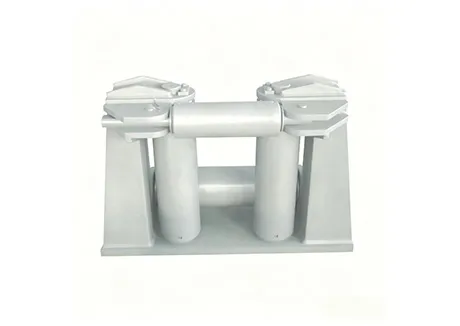
The double bitt bollard uses two vertical posts connected by a shared base, allowing multiple mooring lines to be secured simultaneously. This configuration significantly increases load capacity and improves rope management.
Key Characteristics:
Higher SWL than single bitt designs
Supports parallel mooring line arrangement
Better resistance to dynamic and eccentric loads
Typical Applications:
General cargo ships
Bulk carriers
Tankers
Medium to large port terminals
Design Note: The spacing between the two bitts must be sufficient to allow clean rope handling without excessive friction or cross-loading.
The T-head bollard is the most widely used bollard type in modern commercial port and terminal design. Its distinctive T-shaped top cap allows mooring lines to be looped over the head at a wide range of angles without excessive bending stress on the rope.
Key Characteristics:
Accommodates large rope approach angles (up to 90° in some configurations)
High mooring capacity — available in a wide range of SWL ratings
Reduced stress concentration on synthetic and wire ropes
Preferred by PIANC guidelines for high-capacity berths
Typical Applications:
Container terminals
LNG and LPG terminals
Offshore loading facilities
Large commercial harbors
FPSO and offshore platform mooring
Why It Dominates: The T-head geometry distributes rope load across a larger contact area, reducing wear on both the rope and the bollard surface. For terminals handling large vessels with high mooring loads, this translates directly into lower maintenance costs and improved safety margins.
The kidney bollard features a curved, kidney-shaped profile that guides mooring lines smoothly around the fitting. This design minimizes abrupt changes in rope direction, reducing stress concentration and line abrasion.
Key Characteristics:
Smooth, continuous rope contact surface
Reduced line wear compared to angular designs
Stable performance under variable load directions
Typical Applications:
Port and wharf systems
Medium-duty mooring operations
Applications where rope preservation is a priority
Horn bollards incorporate protruding lateral arms (horns) that physically prevent mooring lines from riding up and slipping off the bollard under load. This makes them particularly valuable in applications where mooring line geometry changes frequently or where multi-directional loads are expected.
Key Characteristics:
Positive rope retention under variable load angles
Suitable for multi-directional mooring configurations
High operational flexibility
Typical Applications:
Offshore terminals and SPM (Single Point Mooring) systems
Tug and workboat operations
Heavy-duty mooring systems with complex line arrangements
Bollard capacity — expressed as Safe Working Load (SWL) — is the most critical specification in any bollard selection process. Undersizing the SWL is the most common and most dangerous error in bollard procurement.
1. Vessel Characteristics
Displacement (DWT or GRT)
Windage area (hull and superstructure)
Vessel beam and length overall (LOA)
2. Environmental Conditions at the Berth
Design wind speed (typically expressed as a return period, e.g., 1-in-50-year event)
Current velocity and direction
Wave height and period
Tidal range and rate of change
3. Mooring Arrangement
Number of mooring lines
Line angles (breast lines, spring lines, head/stern lines)
Mooring line type (synthetic fiber, wire, or combination)
Fairlead positions
4. Operational Factors
Loading/unloading duration
Frequency of vessel calls
Simultaneous operations (e.g., bunkering during cargo operations)
| Application | Typical Bollard SWL |
|---|---|
| Small craft and fishing harbors | 10 – 30 tonnes |
| General cargo and bulk terminals | 50 – 150 tonnes |
| Container and RoRo terminals | 100 – 200 tonnes |
| LNG and LPG terminals | 150 – 300 tonnes |
| Offshore mooring systems | 300+ tonnes |
Important: These ranges are indicative only. Every installation requires a site-specific engineering calculation. Do not select bollard capacity based on general tables alone.
Bollard capacity calculations should be performed in accordance with:
PIANC Working Group 24 — Guidelines for the Design of Fender Systems (also references bollard loads)
BS 6349 — Maritime Structures: Code of Practice for the Design of Quay Walls, Jetties and Dolphins
ISO 13795 — Ships and Marine Technology — Ship’s Mooring and Towing Fittings
Classification society rules — ABS, DNV, BV, LR, CCS, KR (depending on vessel flag and project requirements)
Material selection is as important as bollard type and capacity. Marine bollards operate in one of the most corrosive environments on earth — continuous exposure to saltwater, UV radiation, biological fouling, and mechanical wear.
Cast steel is the standard material for heavy-duty marine and offshore bollards.
Properties:
High tensile strength and impact resistance
Excellent weldability for base plate fabrication
Suitable for high-SWL applications
Can be hot-dip galvanized or epoxy-coated for corrosion protection
Best For:
Commercial port terminals
Offshore platforms and FPSOs
Large vessel mooring systems
Any application requiring SWL above 50 tonnes
Ductile iron offers a cost-effective alternative for medium-duty applications where the extreme strength of cast steel is not required.
Properties:
Good corrosion resistance in sheltered environments
Lower cost than cast steel
Adequate strength for light to medium mooring loads
Best For:
Small ports and fishing harbors
Inland waterway facilities
Secondary mooring points
Limitation: Ductile iron is more brittle than cast steel under impact loading and is generally not recommended for offshore or high-dynamic-load applications.
Stainless steel bollards offer superior corrosion resistance and aesthetic finish, making them appropriate for specialized applications.
Properties:
Excellent resistance to saltwater corrosion (Grade 316L preferred)
Long service life with minimal maintenance
High-quality surface finish
Best For:
Luxury marinas and yacht harbors
Specialized offshore environments
Applications where appearance and corrosion resistance are both priorities
Limitation: Higher material cost makes stainless steel impractical for large-scale commercial terminal installations.
Although ship bollards and dock bollards perform the same fundamental function — securing mooring lines — their design requirements differ significantly.
| Design Factor | Ship Bollard | Dock Bollard |
|---|---|---|
| Installation location | Onboard vessel (deck-mounted) | Fixed quay, jetty, or terminal structure |
| Space constraints | Highly constrained — compact design required | More space available for larger base structures |
| Loading character | Dynamic — vessel motion, vibration, impact | Predominantly static with periodic dynamic events |
| Weight sensitivity | Weight is a design constraint | Weight is less critical |
| Structural integration | Welded to ship’s deck structure | Anchored to concrete or steel quay structure |
| Maintenance access | Limited — requires dry-dock or at-sea inspection | Accessible for routine inspection and maintenance |
Understanding these differences is essential when specifying bollards for a new vessel build, a port upgrade, or an offshore installation.
Offshore mooring environments impose significantly more demanding conditions on bollard systems than standard harbor operations. Engineers specifying bollards for offshore applications must account for:
Extreme Environmental Loading
Design wind speeds of 50+ m/s in some regions
Significant wave heights exceeding 10–15 m
Strong tidal currents
Dynamic and Cyclic Loading
Continuous vessel motion creates cyclic fatigue loading on bollard structures
Fatigue life must be explicitly calculated, not assumed
Corrosion Severity
Offshore splash zones experience the most aggressive corrosion conditions
Coating systems must be specified to offshore standards (e.g., NORSOK M-501)
Certification Requirements
Offshore bollards typically require third-party certification from DNV, ABS, or BV
Material traceability and mill certificates are mandatory
Recommended Specification for Offshore Bollards:
T-head or horn bollard configuration for high-capacity, multi-directional loading
Cast steel construction (Grade LCC or equivalent)
Hot-dip galvanizing plus epoxy topcoat, or thermally sprayed aluminum (TSA) coating
DNV, ABS, or BV type approval
Full material traceability documentation
Compliance with recognized international standards is not optional for commercial marine projects. Classification societies, port authorities, and project owners routinely require documented compliance as a condition of equipment acceptance.
| Society | Abbreviation | Primary Jurisdiction |
|---|---|---|
| American Bureau of Shipping | ABS | USA and international |
| Det Norske Veritas | DNV | Norway and international |
| Bureau Veritas | BV | France and international |
| Lloyd’s Register | LR | UK and international |
| China Classification Society | CCS | China |
| Korean Register | KR | South Korea |
ISO 13795 — Ships and marine technology: mooring and towing fittings
PIANC Guidelines — Port and harbor engineering, including mooring load calculations
BS 6349 — Maritime structures design code
EN 13411 — Terminations for steel wire ropes (relevant for wire mooring systems)
When procuring bollards for a classified vessel or a port project subject to regulatory oversight, always request the supplier’s type approval certificates and test reports.
Even the highest-quality bollard will fail prematurely without a structured maintenance program. Given that bollard failure can result in vessel loss, personnel injury, and significant liability, maintenance is not a cost to be minimized — it is a risk management investment.
Visual Inspection (Monthly or After Significant Mooring Events)
Check for visible cracks, deformation, or impact damage
Inspect coating condition — note any areas of rust, blistering, or mechanical damage
Verify that anchor bolts are tight and undamaged
Check weld integrity at base plate connections
Inspect for signs of corrosion at deck penetrations (ship bollards)
Detailed Inspection (Annual)
Non-destructive testing (NDT) of welds and high-stress areas
Thickness measurement of corroded areas
Full coating assessment and repainting if required
Review of load history — has the bollard been subjected to overload events?
Documentation
Maintain an inspection log for each bollard
Record any repairs, recoating, or replacement of components
Retain records for classification society review
| Failure Mode | Cause | Preventive Action |
|---|---|---|
| Base weld cracking | Fatigue from cyclic loading | Regular NDT inspection |
| Corrosion perforation | Coating breakdown in splash zone | Annual recoating program |
| Anchor bolt loosening | Vibration and dynamic loading | Torque check at each inspection |
| Surface wear | Rope abrasion over time | Monitor contact surfaces; apply wear-resistant coating |
Selecting the right ship bollard is a technical decision with direct consequences for vessel safety, port efficiency, and long-term operational cost. There is no universal bollard that suits every application — the correct choice depends on a careful analysis of vessel type, mooring loads, environmental conditions, installation constraints, and applicable standards.
The key principles to apply in any bollard selection process are:
Calculate SWL from first principles — do not rely on rule-of-thumb estimates
Match bollard type to rope geometry and load direction — T-head for large angle variations, horn bollards for multi-directional loads
Specify material for the actual environment — cast steel for heavy-duty and offshore; stainless steel where corrosion resistance is paramount
Require certified products — ABS, DNV, BV, or equivalent type approval
Implement a structured maintenance program — inspection, documentation, and timely repair
For port developers, offshore project engineers, shipbuilders, and vessel operators, the bollard is a small component with an outsized impact on operational safety. Investing in correct specification, quality manufacturing, and disciplined maintenance is the most cost-effective approach to reliable mooring performance.
The T-head bollard is the most widely used type in modern commercial port and terminal design. Its T-shaped cap accommodates large rope approach angles and high mooring loads, making it the preferred choice for container terminals, LNG berths, and large commercial harbors.
Cast steel is the standard material for heavy-duty marine and offshore bollards. It offers high tensile strength, good impact resistance, and compatibility with protective coating systems. For applications requiring superior corrosion resistance, Grade 316L stainless steel is preferred.
SWL is determined through engineering analysis that accounts for vessel displacement, windage area, environmental forces (wind, current, waves), mooring line arrangement, and applicable design standards such as PIANC guidelines and BS 6349. Each installation requires a site-specific calculation.
Yes, significantly. Offshore bollards must withstand higher dynamic and cyclic loads, more severe corrosion conditions, and extreme weather events. They typically require third-party certification (DNV, ABS, or BV), enhanced coating systems, and full material traceability documentation.
Visual inspections should be conducted monthly and after any significant mooring event. Detailed inspections, including non-destructive testing of welds and thickness measurements of corroded areas, should be performed annually. All inspections should be documented for classification society review.
Key standards include ISO 13795 (mooring and towing fittings), PIANC guidelines (port engineering and mooring loads), and BS 6349 (maritime structures design). Classification society rules from ABS, DNV, BV, LR, CCS, or KR apply depending on the vessel flag and project requirements.
Looking for certified marine bollards for your port, vessel, or offshore project? Explore Normanship’s range of ship mooring equipment, including T-head bollards, double bitt bollards, and offshore-rated mooring fittings — all available with major classification society approvals.


 English
 Español
 italiano
 português
 Nederland
 norsk
norsk