A marine crane is rarely evaluated by lifting capacity alone. On a working vessel, the crane must reach the required handling points, operate safely within the vessel’s available deck area, and remain practical when the boom is parked or folded. Increasing one parameter can directly affect the others. A longer boom may extend working radius but increase lifting moment and foundation loads, while a larger crane may provide more capacity at the cost of additional weight and deck space.
For this reason, effective marine crane design is based on the relationship between lifting capacity, working radius, operating envelope, and deck footprint. The objective is not to maximize one specification, but to create a crane configuration that covers the vessel’s actual handling requirements without creating unnecessary structural or spatial demands.
Lifting capacity only tells part of the performance story. The same crane may handle a different permissible load at different working radii because the load creates a greater overturning moment as the horizontal distance from the crane’s center increases.
For vessel applications, the load-radius relationship should therefore be established before selecting the crane. Instead of asking only “How much can the crane lift?”, engineers should determine:
What is the maximum required load?
At what radius must that load be handled?
Which lifting points are most frequently used?
Where are the most demanding load-radius combinations located?
This approach provides a more realistic basis for selecting ship cranes. A crane with a high headline capacity may not be the best solution if its useful capacity decreases significantly at the vessel’s required outreach.
Working radius has a direct influence on crane geometry, structural loads, and foundation requirements. As outreach increases, the lifting moment generally increases even when the lifted load remains unchanged. This means a longer reach cannot simply be added without considering the resulting impact on the crane base and supporting deck structure.
A practical design process begins by mapping the vessel’s actual handling points. These may include cargo transfer areas, machinery spaces, storage locations, maintenance zones, or over-the-side lifting positions. Once these points are identified, the required working radius can be established more accurately.
This often reveals an important optimization opportunity: the crane does not always need the longest possible boom if its mounting position can be optimized. Positioning the crane closer to the main handling area may reduce the required outreach, which can help control structural loads and preserve deck space.
Reach and deck utilization should be designed together rather than treated as separate requirements. A crane with a long fixed boom may achieve the required radius but occupy valuable working space, particularly when the vessel has a crowded deck layout.
Several design considerations can improve the balance:
Optimize crane position: Locate the crane where it can serve the greatest number of handling points with reasonable outreach.
Use an appropriate boom configuration: Folding or articulated arrangements can provide useful reach while reducing the crane’s parked envelope.
Define the required slewing sector: Full 360-degree rotation may not always be necessary.
Check the stowed position: The crane should not obstruct walkways, hatches, equipment, or other deck operations when inactive.
These decisions can make a significant difference on vessels where every square meter of deck area has an operational purpose.
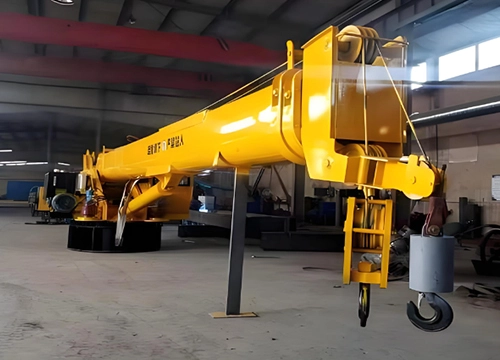
A deck crane can be particularly suitable when lifting operations must be performed directly from the vessel deck and available installation space is limited. Its configuration can be planned around the vessel’s deck layout, cargo-handling requirements, and access limitations.
However, “compact” should not be interpreted simply as having a small physical footprint. A properly optimized deck crane must also provide sufficient working coverage without interfering with surrounding equipment.
Before installation, the design team should evaluate both the crane foundation and the complete operating envelope. The foundation occupies permanent space, while the boom and lifted load require additional dynamic and operational clearance during use.
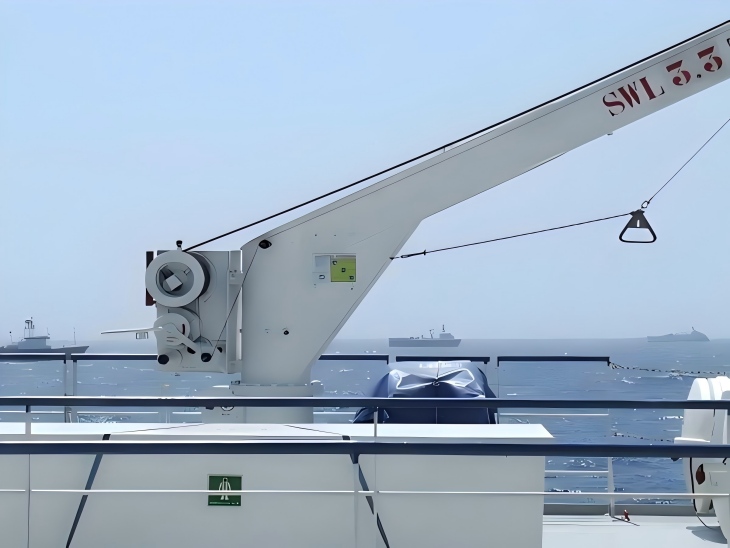
There is no universal boom configuration for every vessel. The right arrangement depends on the relationship between required capacity, outreach, lifting height, working sector, and available deck space.
For vessels with restricted operating areas, articulated or folding boom configurations can offer an advantage because the boom can be positioned more efficiently when the crane is not being used. This is particularly useful when the deck must accommodate cargo, access routes, or other machinery.
A marine knuckle boom crane, for example, uses an articulated boom arrangement that can provide flexibility when lifting operations take place around structures or within relatively confined areas. The configuration can also reduce the space required for stowage compared with some conventional straight-boom arrangements.
Slewing range determines how much of the surrounding deck or over-side area can be reached from a fixed crane foundation. More rotation is not automatically better. The useful question is whether the available slewing range covers the vessel’s required working sector.
If cargo is handled within a defined section of the deck, a crane designed around that operating sector may provide sufficient coverage without unnecessarily increasing the complexity or footprint of the system.
A slewing crane should therefore be assessed according to its useful working coverage, not simply its theoretical rotation capability. Obstructions such as cabins, containers, railings, exhaust systems, pipelines, and other deck equipment must be considered when defining the actual working envelope.
Deck-space analysis should go beyond measuring the crane base. A useful way to evaluate the installation is to divide the required space into four zones:
| Zone | What It Includes | Why It Matters |
|---|---|---|
| Foundation Zone | Crane base and structural reinforcement | Determines permanent deck occupation and load transfer requirements |
| Operating Zone | Boom movement and lifted-load area | Defines clearance requirements during lifting |
| Stowage Zone | Folded, retracted, or parked boom | Determines how much deck space remains available when idle |
| Maintenance Zone | Access around hydraulic, electrical, and mechanical components | Ensures inspection and servicing remain practical |
This four-zone approach provides more useful information than comparing crane base dimensions alone. A crane may have a compact foundation but still consume considerable space through its operating or maintenance envelope.
No. Oversizing a marine crane can create unnecessary costs and structural requirements without improving the vessel’s actual lifting operation.
A higher-capacity crane may require a stronger foundation, greater structural reinforcement, additional hydraulic or electrical capacity, and more installation space. It can also add unnecessary weight to the vessel.
The better approach is to establish the vessel’s critical load-radius combinations first and then select a crane that provides an appropriate safety margin. The target should be capacity that matches the real duty cycle, rather than maximum capacity for its own sake.
Before a crane configuration is approved, the shipyard, crane supplier, and vessel designer should confirm the following parameters:
| Design Factor | Why It Matters | What Should Be Evaluated |
|---|---|---|
| Safe Working Load | Defines the permissible lifting load | Capacity at each critical working radius |
| Working Radius | Determines horizontal reach | Nearest and farthest lifting points |
| Lifting Moment | Connects load with outreach | Structural and foundation loads at critical positions |
| Slewing Range | Determines working coverage | Required operating sector and potential obstructions |
| Deck Footprint | Consumes permanent working area | Foundation dimensions and surrounding clearance |
| Stowed Envelope | Affects deck availability when idle | Folded or retracted boom position |
Power supply, hydraulic system requirements, structural reinforcement, maintenance access, corrosion protection, classification requirements, and emergency operating considerations should also be reviewed before the final configuration is released for construction.
The most effective marine crane is not necessarily the one with the highest lifting capacity or longest reach. It is the one whose performance envelope fits the vessel’s actual operating requirements.
A practical optimization sequence is:
Identify the loads that must be handled.
Map the required lifting points and working sectors.
Determine the critical load-radius combinations.
Position the crane to minimize unnecessary outreach.
Select a boom configuration that provides the required reach while controlling the stowed envelope.
Verify foundation loads and deck reinforcement requirements.
Check operating, stowage, and maintenance clearances.
This method shifts the design focus from individual specifications to the complete crane operating envelope. For shipyards and vessel operators, that can result in a crane that delivers the required lifting performance while preserving valuable deck space and avoiding unnecessary structural or equipment capacity.


 English
 Español
 italiano
 português
 Nederland
 norsk
norsk