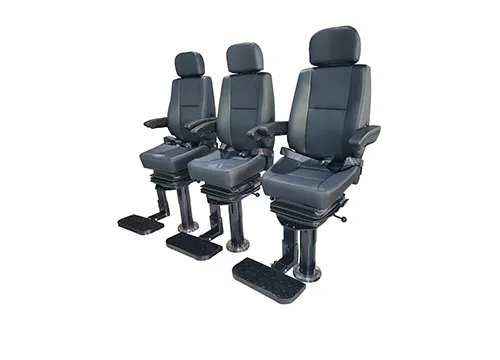
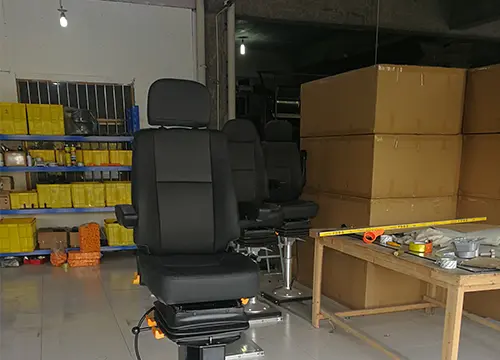
A fixed marine pilot chair is usually the better option when the helm requires a permanent and precisely positioned operator station. An unfixed pilot chair is more suitable when the wheelhouse needs flexible seating that can be repositioned or when permanent deck mounting is undesirable.
The important distinction is that “fixed” describes how the chair is mounted—not how adjustable the seat is. A deck-fixed chair can still swivel, slide, recline, change height, and provide extensive ergonomic adjustment.
A fixed pilot chair uses a pedestal, foundation, rail system, or other arrangement secured to the vessel structure.
Its main advantage is positional consistency. Once installed, the base remains at a defined distance from the helm, controls, displays, and bridge console.
Among marine chairs for boats, fixed installation does not necessarily mean limited movement. Many wheelhouse chairs use a secured base with adjustable components above it.
This is useful for a permanent control position because the operator can modify the seating posture without moving the complete chair away from the workstation.
ISO 8468:2007 emphasizes bridge configuration and workstation arrangement as part of supporting safe and effective ship operation, which is why chair selection is best considered together with the surrounding bridge geometry.
An unfixed pilot chair is not permanently secured to one deck position.
Instead, the complete chair can be repositioned within the available bridge area. This can be valuable on vessels where seating must serve more than one function or where operators need to free up floor space when the chair is not in use.
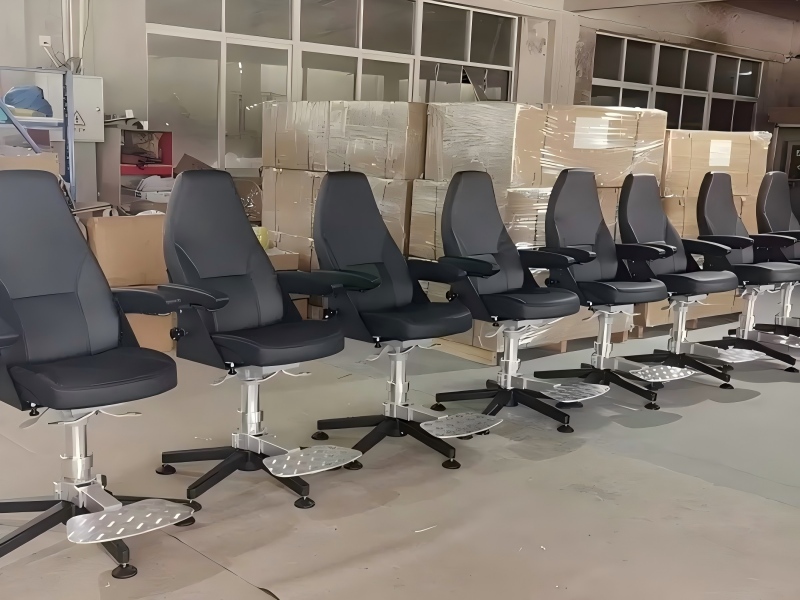
Normanship's current unfixed pilot chair uses an aluminum five-star base and is specifically described as not requiring deck drilling.
This makes installation and repositioning simpler, but it also changes how the chair should be evaluated.
With a fixed installation, the relationship between the chair and the controls is predetermined. With an unfixed chair, the operator has greater freedom to change that relationship, so bridge layout, vessel motion, deck condition, and intended use become especially important.
| Selection Factor | Fixed Pilot Chair | Unfixed Pilot Chair |
|---|---|---|
| Deck attachment | Secured to vessel structure | No permanent deck fixing |
| Position relative to controls | Consistent | Can be changed |
| Installation work | Requires mounting provision | Usually simpler |
| Bridge layout flexibility | Moderate | High |
| Operator adjustment | Can still be extensive | Depends on model |
| Repositioning | Limited to built-in travel | Entire chair can move |
| Typical application | Dedicated helm station | Flexible bridge space |
| Deck drilling | Usually required | May be avoided |
| Vessel-motion consideration | Base remains defined | Requires closer evaluation |
The table is a selection guide rather than a universal safety rule. Final mounting arrangements should match the vessel design, operating condition, and applicable project requirements.
A securely installed fixed chair has one obvious advantage: its base remains in a defined position relative to the helm.
This can be particularly useful where the operator continuously uses the same steering and propulsion controls.
However, it does not mean that every fixed chair provides the same level of support or that every unfixed chair is unsuitable onboard a vessel.
Installation quality, pedestal design, seat geometry, structural attachment, and the operating environment still matter.
A fixed adjustable boat chair can be a practical solution where the vessel requires a permanent chair position but several operators need different seating positions.
Current Normanship adjustable pilot chair specifications illustrate this arrangement: the chair can provide fore/aft movement, rotation, backrest and headrest adjustment, foot support, and vertical adjustment even though the working position is based around a defined installation.
This is why buyers should separate two questions: “Does the entire chair need to move?” and “Does the operator need an adjustable seating position?”
An unfixed pilot chair makes sense when movable seating provides a genuine operational benefit.
One example is a large wheelhouse where the operator occasionally changes workstation. Another is a bridge where additional floor space is needed when the chair is not in use.
It can also be attractive during refit projects when drilling a new permanent chair foundation is undesirable.
However, installation convenience should not be the only reason for selecting an unfixed pilot chair.
The designer or operator should consider how the chair behaves as the vessel rolls, pitches, accelerates, or changes heading. Floor surface, chair footprint, center of gravity, operator position, and available clearance can all affect practical use.
The movable configuration should therefore be selected because it fits the bridge's operating concept, not simply because it is easier to place onboard.
A fixed chair is usually preferable when one operator position is closely associated with one control console.
In this arrangement, the designer can establish a predictable relationship between seat height, steering wheel, displays, propulsion controls, sightlines, and foot support.
A fixed installation can still provide a large adjustment envelope.
For example, helm chairs for boats may combine a secured installation with rail movement, swivel, vertical adjustment, and adjustable back support. Normanship's current helmsman model includes a double-slide rail, fore/aft movement, rotation, adjustable backrest and headrest, armrests, foot support, and vertical lifting.
For many commercial wheelhouses, this combination provides the practical middle ground: the chair remains associated with the helm, while individual operators can still adjust their working position.
Yes.
This is one of the most important points when comparing fixed and unfixed seating.
Fixed refers to the relationship between the chair foundation and the deck. It does not prevent the upper seat assembly from rotating or moving.
A deck-fixed pilot chair marine arrangement may include:
360-degree swivel;
fore/aft slide;
vertical seat adjustment;
adjustable backrest;
folding armrests;
adjustable foot support.
The exact functions depend on the chair model and bridge requirements.
This means that a buyer should not select an unfixed chair simply because different crew members need different seating positions. An adjustable fixed chair may already provide sufficient movement while preserving a permanent relationship with the controls.
For a shared helm station, adjustment is usually more important than the ability to move the entire chair.
Different operators need different distances from the console and different seat heights. An adjustable boat seat can accommodate these differences through built-in mechanisms while keeping the base at one engineered location.
This is often useful on commercial vessels where several crew members use the same helm during different watches.
An unfixed chair becomes more attractive when the workstation itself changes—for example, when the same chair must serve different parts of the wheelhouse.
The difference is therefore straightforward:
If the operator position changes, choose adequate seat adjustment.
If the workstation position changes, consider whether an unfixed chair provides additional value.
It can, depending on the chair design and operating environment.
The practical behavior of a movable chair depends on factors such as base geometry, friction between the base and deck, center of gravity, operator weight, deck inclination, and vessel acceleration.
For that reason, an unfixed chair that feels stable when the vessel is alongside should not automatically be assumed to behave identically at sea.
The expected vessel motion should form part of the selection process.
Where maintaining an exact operator-to-control position is essential, a fixed chair generally provides a simpler way to achieve predictable positioning.
Where freedom of movement is more important, an unfixed design may still be appropriate after the operating conditions have been evaluated.
Suspension is a separate decision from fixed versus unfixed mounting.
Vessels exposed to significant shock or vibration may benefit from a chair designed to isolate part of this motion from the operator.
For such applications, suspension seats for boats may be more relevant than simply choosing between a conventional fixed or movable base.
The need for suspension depends on the vessel's speed, operating environment, hull behavior, and the amount of time the operator spends seated.
A large cargo ship and a fast offshore workboat can therefore have very different seating priorities even if both use a marine pilot chair.
Measure the bridge before selecting the chair.
Start with the proposed seat centerline and determine its relationship with the primary controls. Check console height, knee clearance, required sightlines, deck-to-seat height, available floor area, and footrest position.
For an adjustable or swiveling chair, measure the complete movement envelope rather than just the base dimensions.
A chair may fit within the available floor space but still strike the console when rotated. Armrests and backrests can also require considerably more clearance than the pedestal itself.
For an unfixed pilot chair, determine whether there is genuinely enough free floor area to make repositioning useful. If surrounding equipment restricts movement to only a few centimeters, a fixed adjustable seat may make better use of the available space.
Choose according to how the bridge is actually operated.
Use a fixed chair when:
the seat belongs to a dedicated helm station;
consistent positioning relative to controls is important;
several operators can be accommodated through seat adjustment;
the vessel's operating environment favors a secured base.
Consider an unfixed chair when:
the entire seating position genuinely needs to move;
bridge floor space is used for multiple functions;
permanent deck fixing is undesirable;
the vessel's operating conditions are appropriate for movable seating.
A good pilot chair supplier should therefore ask about the vessel and bridge arrangement before recommending a chair.
The choice is not simply fixed versus unfixed. Buyers should consider mounting, fore/aft travel, swivel range, height adjustment, armrest and footrest configuration, suspension requirements, available floor area, and the operator's relationship with the navigation controls as one complete workstation decision.
No. Its suitability depends on bridge layout, vessel motion, intended use, and project requirements. Movable seating should be evaluated in the context of the actual operating environment.
Yes. A fixed deck mounting does not prevent the upper chair from rotating. Many fixed helm chairs also provide sliding and vertical adjustment.
Not necessarily. Some designs use a freestanding base specifically to avoid permanent deck mounting. Normanship's five-star-base model is one current example.
A fixed but highly adjustable chair is often suitable because each operator can change seat height, fore/aft position, backrest, and other settings without moving the entire workstation.
No. “Adjustable” describes movement available to the operator, while “unfixed” describes the way the entire chair is installed. A fixed chair can still be highly adjustable.
Available space should guide the decision. A fixed chair can prevent unintended changes in the working position, while a movable chair may be useful if it can be moved away to free floor space. Measure both the installed footprint and the full operating movement before ordering.


 English
 Español
 italiano
 português
 Nederland
 norsk
norsk