Choose a marine pilot chair according to the operator's working position, bridge console geometry, required visibility, vessel motion, and expected watch duration. For most commercial wheelhouses, the most useful features are not decorative extras but practical adjustments that let different operators reach controls comfortably while maintaining a stable working position.
A pilot chair marine installation should therefore be considered part of bridge workstation design rather than a standalone furniture purchase. ISO 8468:2007 addresses bridge arrangement, bridge workstations, and bridge environment with the objective of supporting safe and effective vessel operation.
Start with the actual bridge workstation.
Measure where the operator needs to sit relative to the wheel, propulsion controls, displays, communication equipment, and forward windows. A chair that feels comfortable in a showroom can still be unsuitable if the operator constantly has to lean forward to reach frequently used controls.
When comparing marine chairs, evaluate the functions that affect the operator's real working position:
| Feature | What to Evaluate | Why It Matters |
|---|---|---|
| Seat height | Adjustment range and locking | Supports operators of different heights |
| Fore/aft slide | Travel distance | Sets correct distance from controls |
| Rotation | Swivel range and positioning | Helps access surrounding workstations |
| Backrest | Support and adjustment | Important during longer watches |
| Armrests | Folding or adjustable design | Can support arms without blocking controls |
| Footrest | Height and folding range | Important on elevated helm stations |
| Suspension | Shock and vibration isolation | Useful on higher-motion vessels |
| Base design | Fixed, rail-mounted or unfixed | Determines installation and movement |
The best chair is the one that fits the bridge workflow without forcing the operator into an awkward posture.
A marine pilot chair used by multiple crew members should normally provide enough adjustment to accommodate different body dimensions and operating preferences.
Seat height is one of the most important variables because it affects both forward visibility and the relationship between the operator and the control console.
Fore-and-aft movement is equally useful. A tall operator may need more distance from the console, while a shorter operator may need to move closer without leaning forward.
A suitable adjustable boat chair can combine these adjustments with backrest, headrest, armrest, swivel, and footrest functions. Normanship's current adjustable pilot chair, for example, includes fore/aft travel, 360-degree rotation, adjustable backrest and headrest, armrest adjustment, foot-pedal adjustment, and vertical column movement.
The goal, however, is not to specify the chair with the greatest number of adjustments. Every mechanism should solve an actual workstation requirement.
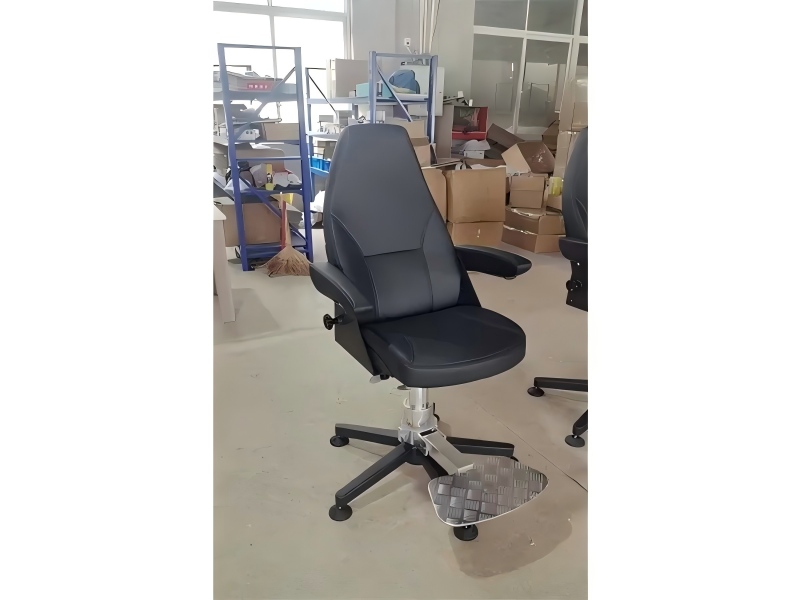
There is no universal seat height for every wheelhouse.
The correct height depends on window geometry, console height, operator stature, instrument arrangement, and whether the chair includes a footrest.
Instead of specifying only one finished seat height, it is often better to define a practical adjustment range.
At the lowest and highest positions, verify three things:
The operator maintains the required external sightline.
Frequently used controls remain within comfortable reach.
The operator's legs and feet remain properly supported.
This is particularly important for a high pilot chair. Raising the seat without providing suitable foot support may improve visibility while creating a poor lower-body working position.
In marine purchasing, the names frequently overlap.
Terms such as marine pilot chair, pilot chair, pilot chair marine, captain chair, helm chair, and helmsman chair can all describe seating installed around a vessel's command or navigation position.
The more useful distinction is the operational function.
A chair at a dedicated forward helm may primarily need correct seat height and fore/aft adjustment. A helmsman who frequently turns toward wing controls, side windows, or surrounding navigation equipment may benefit from greater rotational movement.
For this type of workstation, helmsman seats for boats with sliding and swivel functions can provide a broader operating envelope. Normanship's current helmsman chair combines a double-slide rail with fore/aft adjustment, rotation, adjustable backrest and headrest, armrests, foot support, and vertical movement.
The name of the product therefore matters less than whether its movement range matches the operator's duties.
For a permanent helm station, a fixed mounting is usually the most straightforward arrangement because it maintains a predictable relationship between the operator and the controls.
However, “fixed” should not be confused with “non-adjustable.”
A chair can be secured to the deck while the seat itself still slides, swivels, reclines, or changes height. This distinction is important when discussing requirements with a pilot chair supplier.
Some wheelhouses instead require movable seating. An unfixed chair can be useful where the operator works at different positions or where permanent drilling into the deck is undesirable.
Normanship's current five-star-base pilot chair, for example, is described as an unfixed design that does not require deck drilling.
The suitability of a movable chair still needs to be evaluated against vessel motion and the operational requirements of the bridge.
Not every vessel needs a suspension seat.
The decision depends largely on the motion and shock environment experienced at the helm.
A large commercial vessel operating at relatively moderate bridge accelerations may place different demands on a pilot chair from a fast workboat, patrol craft, offshore vessel, or other craft exposed to repeated impact and vertical acceleration.
In the latter applications, a marine suspension seat may help create a more suitable working position for the operator by isolating part of the motion between the chair and occupant.
Suspension should therefore be treated as an operational feature rather than simply as an indicator of a more expensive seat.
The adjustment range of the suspension mechanism is also important. If weight adjustment or travel is unsuitable for the operator, the system may not perform as intended.
Material selection depends strongly on where the chair will be installed.
An enclosed, climate-controlled bridge has different environmental exposure from an open wheelhouse or semi-exposed control station.
For the chair structure, buyers should consider corrosion resistance, mechanical durability, and the long-term condition of slides, swivels, fasteners, and adjustment mechanisms.
For upholstery, consider wear resistance, cleaning requirements, moisture exposure, and whether project-specific flame-retardant requirements apply.
It is also useful to look beyond the visible seat surface. A marine chair may remain in service for years, so the ability to maintain or replace adjustment mechanisms, armrests, cushions, slides, or base components can influence its total service value.
Long watch periods make workstation geometry more important.
A thick cushion cannot compensate for a chair that places the operator too far from the controls or requires repeated forward leaning.
For continuous or extended use, prioritize a chair that lets the operator make small posture changes without leaving the working position. Useful functions may include seat height adjustment, fore/aft movement, backrest adjustment, arm support, and a properly positioned footrest.
The operator should also be able to enter and leave the seat without the armrests or console creating unnecessary obstruction.
When the chair rotates, check the complete turning envelope. A pilot chair may technically provide 360-degree swivel but be unable to use it after installation because the backrest or armrests interfere with the console.
A bridge layout is much more useful than simply asking for a catalogue of pilot chairs.
Provide the available floor area, console dimensions, approximate seat centerline, required seat-height range, desired fore/aft travel, swivel requirements, and mounting preference.
If the chair will replace an existing seat, provide the base or foundation dimensions and photographs of the current installation.
The pilot chair supplier should also know the vessel type and expected operating environment. A wheelhouse chair for a large cargo vessel may be specified differently from seating for a workboat or high-speed craft.
This information allows the supplier to recommend a pilot chair based on the actual vessel rather than only on appearance or catalogue dimensions.
A marine pilot chair provides the helmsman, captain, or navigation operator with a defined working position at the ship bridge or wheelhouse. Its design should support visibility, access to controls, and an appropriate seated posture.
Many marine pilot chair models provide full rotation, but full swivel is not necessary for every vessel. The useful question is whether the required control positions can be reached and whether the chair can be positioned securely during operation.
They can improve support during long operating periods, but they should not interfere with steering controls or entry and exit. Folding or adjustable armrests are often useful where the operator's duties change.
A fixed chair is generally suitable for a dedicated helm position where a predictable relationship with the controls is important. A movable chair offers more layout flexibility. Vessel motion, bridge configuration, and operational requirements should determine the choice.
Confirm the mounting arrangement, installation dimensions, adjustment range, bridge console geometry, operator requirements, vessel operating conditions, upholstery requirements, and any project-specific approval or fire-performance requirements before finalizing the chair.


 English
 Español
 italiano
 português
 Nederland
 norsk
norsk