Underwater salvage operations often involve recovering sunken vessels, submerged equipment, or heavy objects from challenging marine environments. Selecting appropriate buoyancy equipment is an important part of planning these projects, particularly when the operation involves limited underwater access, changing water conditions, and complex lifting requirements.
Underwater lifting bags provide additional buoyancy by using air to displace water. They are used in marine salvage, underwater construction, vessel recovery, and other professional lifting applications.
However, selecting a salvage airbag requires more than matching its rated capacity to the estimated weight of an object. Engineers must also evaluate operating depth, existing buoyancy, lifting-point strength, bag configuration, and environmental conditions.
This guide explains the main selection factors for underwater salvage airbags and provides a practical checklist for marine equipment buyers.
Underwater salvage airbags are inflatable buoyancy devices designed to support controlled lifting or flotation operations.
They operate according to Archimedes' principle: an object submerged in water experiences an upward buoyant force equal to the weight of the water it displaces.
When an airbag is inflated underwater, it displaces water and creates additional upward force. This buoyancy can help support a submerged load when the equipment is appropriately rated and integrated into a professionally engineered lifting arrangement.
Typical applications include:
Recovering submerged equipment or marine structures.
Supporting sunken vessel recovery projects.
Providing temporary buoyancy during underwater construction.
Assisting with selected offshore maintenance operations.
Supporting controlled flotation of suitable submerged objects.
Unlike equipment used primarily for lifeboat rescue, salvage lifting airbags are designed for moving or supporting underwater loads rather than evacuating or transporting people.
These applications involve different equipment standards, operational risks, and safety requirements.
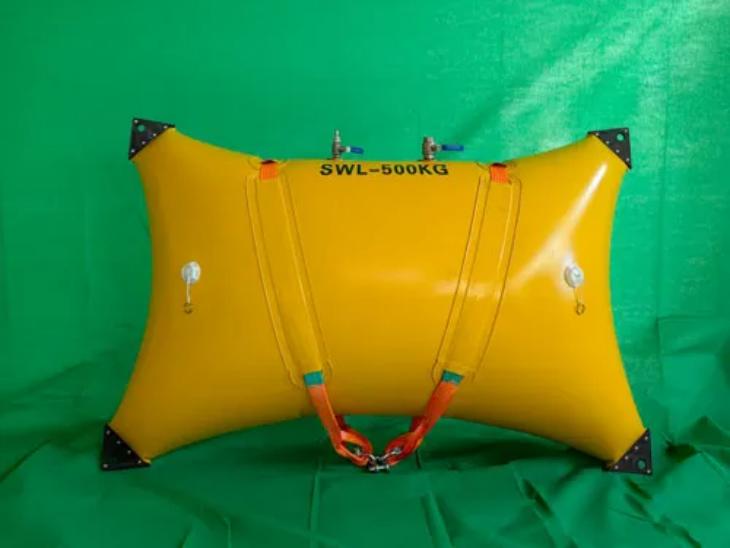
Buoyancy capacity is one of the most important considerations when selecting a salvage airbag.
The required additional lift depends on the object's effective submerged weight, which differs from its weight in air because the object already displaces water.
The basic relationship is:
Effective submerged weight = Weight in air − Existing buoyant force
For example, a submerged object weighing 5,000 kg in air may have a lower effective weight underwater because of the water it displaces.
However, the actual calculation must consider material density, trapped water or air, attachments, seabed resistance, and other site-specific conditions.
A bag's nominal lifting capacity does not automatically represent the usable lift available at every operating depth or configuration.
Engineers must verify the manufacturer's rating conditions, applicable operating limits, and the expected buoyancy throughout the planned operation.
Additional considerations include load distribution, rigging geometry, potential changes in buoyancy during ascent, and appropriate engineering safety margins.
The final lifting arrangement should be developed and verified by qualified salvage professionals.
Water depth affects the pressure acting on a salvage airbag.
As depth increases, surrounding water pressure rises. For an air-filled bag, its gas volume and resulting buoyancy depend on pressure, inflation conditions, bag design, and other operating factors.
During ascent, decreasing surrounding pressure can cause the gas inside an airbag to expand. Without suitable control arrangements, this may result in rapidly changing buoyancy and unsafe lifting conditions.
Therefore, buyers should verify:
The manufacturer's permitted operating depth.
The bag's rated buoyancy under the specified conditions.
The design and operation of pressure-relief or air-release devices.
Compatibility with the intended lifting arrangement.
Inspection and testing requirements before deployment.
Airbag selection should also account for water density. Seawater generally provides slightly greater buoyancy than freshwater for the same displaced volume.
These factors must be incorporated into an approved salvage plan rather than addressed through assumptions during operation.
Different airbag designs are available for different marine salvage requirements.
| Feature | Pillow-Type Airbags | Parachute-Type Airbags |
|---|---|---|
| General structure | Compact, pillow-shaped body | Suspended, parachute-like profile |
| Typical applications | Underwater recovery and flotation support | Underwater lifting and large salvage operations |
| Storage | Foldable and compact | Foldable when deflated |
| Main selection factors | Available space, attachment, buoyancy capacity | Load configuration, buoyancy capacity, depth and control requirements |
| Important checks | Fabric, valves, attachment points | Fabric, release valves, rigging and rated limits |
The appropriate configuration depends on the approved lifting plan, attachment requirements, underwater conditions, and verified product ratings.
Salvage airbags operate under demanding conditions, so equipment inspection and safety documentation are essential.
Important components to evaluate include:
Airbag fabric: Check the stated material, construction, wear resistance, and compatibility with the intended environment.
Valves: Confirm that inflation, release, and pressure-protection components meet the manufacturer's specified requirements.
Attachment points: Verify that lifting connections and rigging interfaces are compatible with the planned loading conditions.
Product identification: Ensure the equipment has appropriate model identification, rated capacity information, and operating instructions.
Inspection records: Review applicable inspection, maintenance, and testing requirements before use.
Professional underwater lifting operations should be supervised by suitably qualified personnel. Equipment selection and operational procedures must follow the manufacturer's instructions and applicable marine safety requirements.
Providing detailed project requirements helps suppliers recommend suitable equipment.
Before requesting a quotation, prepare the following information:
Intended application and type of submerged object.
Estimated effective submerged load and engineering assessment.
Maximum operating depth and environmental conditions.
Required buoyancy capacity and proposed bag configuration.
Attachment and rigging interface requirements.
Relevant inspection, testing, and documentation requirements.
Quantity, packaging, and delivery schedule.
Selecting underwater salvage airbags requires careful evaluation of buoyancy capacity, operating depth, airbag structure, attachment requirements, and safety provisions.
Although inflatable lifting bags can provide useful buoyancy for submerged loads, their performance depends on the complete lifting arrangement and site conditions.
For marine equipment buyers, reviewing product specifications, operating limitations, and inspection documentation is essential. A technically appropriate selection, supported by a qualified salvage engineering plan, can help improve the reliability and safety of underwater recovery operations.
They are used to provide additional buoyancy during underwater salvage, submerged equipment recovery, marine construction, and selected flotation-support operations.
The selection should consider the effective submerged load, existing buoyancy, operating depth, load distribution, rigging arrangement, and applicable engineering safety requirements.
They differ in shape, configuration, and typical lifting arrangements. The correct choice depends on available space, load requirements, attachment conditions, and the manufacturer's operating specifications.
They are not substitutes for certified lifeboats, rescue boats, or personnel-rescue equipment. Salvage airbags are intended for appropriate underwater lifting and flotation operations, not the transportation or evacuation of people.
Yes. Water pressure affects the volume of gas inside the bag, and buoyancy may change as operating depth changes. Equipment ratings and professional operating procedures must account for these effects.
Provide the application, assessed submerged load, maximum depth, required buoyancy, preferred configuration, attachment requirements, and any relevant testing or documentation specifications.


 English
 Español
 italiano
 português
 Nederland
 norsk